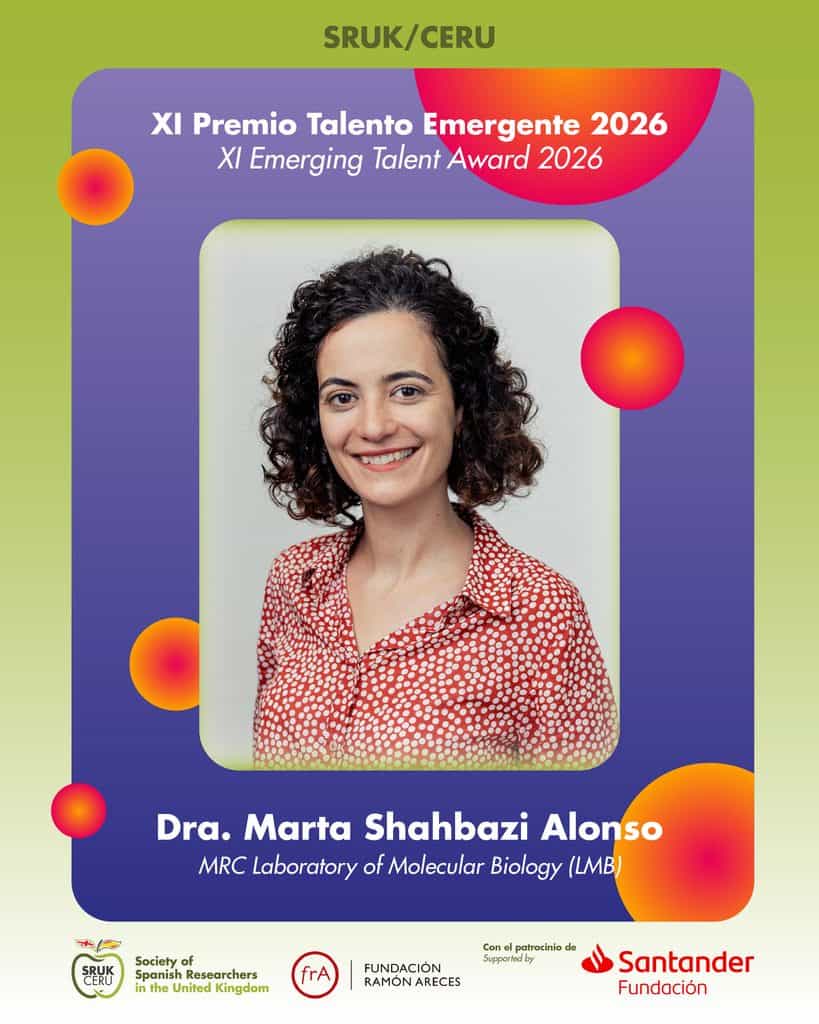
- Banco Santander Foundation, sponsor of the SRUK/CERU Emerging Talent Award, has announced the winner of its 11th edition: Dr Marta Shahbazi Alonso, from MRC Laboratory of Molecular Biology (Cambridge).
- The award recognises her outstanding career track record of internationally recognised contributions to the fields of developmental biology and reproductive medicine.
- The Society of Spanish Researchers in the United Kingdom (SRUK/CERU) and Banco Santander Foundation thus continue their shared mission to support young Spanish researchers with exceptional careers in the UK and to foster collaboration between both countries.
London, 20th October 2026. SRUK/CERU Emerging Talent Award Evaluation Committee, chaired by Dr Jorge Català (Newcastle University), assessed the high-calibre applications received for the 11th edition of the Emerging Talent Award. Dr Jorge Català highlighted, “the quality of all the applications received for the Emerging Talent Award, which illustrates the significant contributions of Spanish researchers in the United Kingdom.”
Dr. Marta Shahbazi Alonso began her career at the Universidad Autónoma of Madrid, where she received an undergraduate degree in Biology and an MSc degree in Molecular Biomedicine. She obtained her PhD at the Spanish National Cancer Research Centre (CNIO) working on the basic mechanisms that preserve the shape and integrity of epidermal stem cells. Then, she joined the University of Cambridge as a postdoctoral researcher to investigate the morphogenesis of the embryo at the time of implantation. She established a system that allows human embryo development beyond implantation in vitro and used it to explore the basic cellular and molecular mechanisms that regulate embryo remodelling. In 2020, she began leading her own research group at the Medical Research Council Laboratory of Molecular Biology. Her independent research career addresses fundamental questions in human embryology with important ethical and clinical implications, including development of methods that provide experimental access to previously inaccessible stages of human development, and investigating how mammalian embryos coordinate tissue morphogenesis with cell fate decisions during implantation. Her group has recently developed genetically tractable three-dimensional stem cell models, including embryonic spheroids and placental organoids, which enable mechanistic studies of embryonic and extra-embryonic development.
In addition to her academic leadership —she actively engages with policymakers, clinicians, industry, and the public, contributing to national discussions on the governance of human embryo research in the UK, collaborating closely with IVF clinics and biotechnology partners, and communicating her research through public engagement activities.
She has received numerous awards including the 2019 3Rs Prize for providing an opportunity to replace and reduce the use of mice in developmental biology studies. Marta’s research has also been recognised with the Suffrage Science award, supported by the MRC Laboratory of Medical Sciences (LMS). In 2024, she joined the EMBO Young Investigator Programme which supports life scientists to receive mentoring and training opportunities, financial and practical support, and become part of an international network.
Marta intends to use the award to develop her existing collaborations and establish new partnerships with Spanish IVF clinics. She will also promote knowledge exchange between clinicians, embryologists, and researchers, via reciprocal visits between her laboratory and collaborating clinics with the aim to build capacity and encourage the development of human embryo research within Spain. She also aims to strengthen communication and community building around human embryo research, for example organizing meetings and workshops with key stakeholders, patient representatives, bioethicists, clinicians and developmental biologists working in Spain. Finally, this award will help her balance and support her family-work life, by including childcare support and promoting a healthy research culture that is compatible with family responsibilities.
Regarding this recognition, Marta Shahbazi stated: “Receiving this award has a very special meaning for me because, after 12 years of pursuing my career outside Spain, being recognized by the Spanish community is particularly moving. I also see it as a recognition of the dedication and collective work of my entire team over these years, and I hope that my career can serve as an inspiration to future generations of Spanish scientists, both in Spain and abroad.”
Borja Baselga, Director of Banco Santander Foundation, noted: “We are pleased to collaborate once again on this initiative, which helps to strengthen scientific collaborations between the United Kingdom and the European Union, promotes the development of policies that support R&D&I, and gives visibility to the research carried out by Spanish scientists in the UK, both within the scientific community and among the general public. This eleventh edition of the SRUK/CERU Emerging Talent Award reinforces the commitment of SRUK/CERU and Banco Santander Foundation to continue forging connections between Spain and the UK, while funding and supporting the innovative projects that outstanding Spanish researchers are developing in the United Kingdom.”
Finally, Dr Sara Franco Ortega, President of SRUK/CERU, indicated that: “For SRUK/CERU, it is a privilege to have Dr Marta Shahbazi Alonso among our list of awardees. Marta perfectly embodies the values of this award through her outstanding scientific career and her commitment to advancing human embryo research. Her research career in Spain and in the UK at the University of Cambridge and the MRC Laboratory of Molecular Biology, reflects both the depth and international dimension of her scientific achievements. We are especially pleased to recognise her pioneering contributions to developmental and stem cell biology and her continued impact on our understanding of early human embryonic development as well as her efforts to foster collaboration and knowledge exchange between researchers and clinicians in the UK and Spain.”