- The traveling exhibition “The Art and Legacy of Santiago Ramón y Cajal”, organised by the Neuroscience Committee of the Society of Spanish Researchers in the UK (SRUK/CERU), was inaugurated yesterday at the University of Bristol.
- The exhibition showcases details of the life, work, and historical ties to the United Kingdom of Santiago Ramón y Cajal, the first Spanish researcher awarded the Nobel Prize, through informative panels and reproductions of his original scientific drawings.
- The exhibition is free and open to the public from 4–6 June at the Wills Memorial Building, Queens Rd, BS8 1RJ, Bristol. It will then move to the School of Psychological Sciences, Priory Road Complex in Bristol, from 10–27 June. The tour will continue to York (4 July) and Edinburgh (September).
Bristol, 5th June, 2025
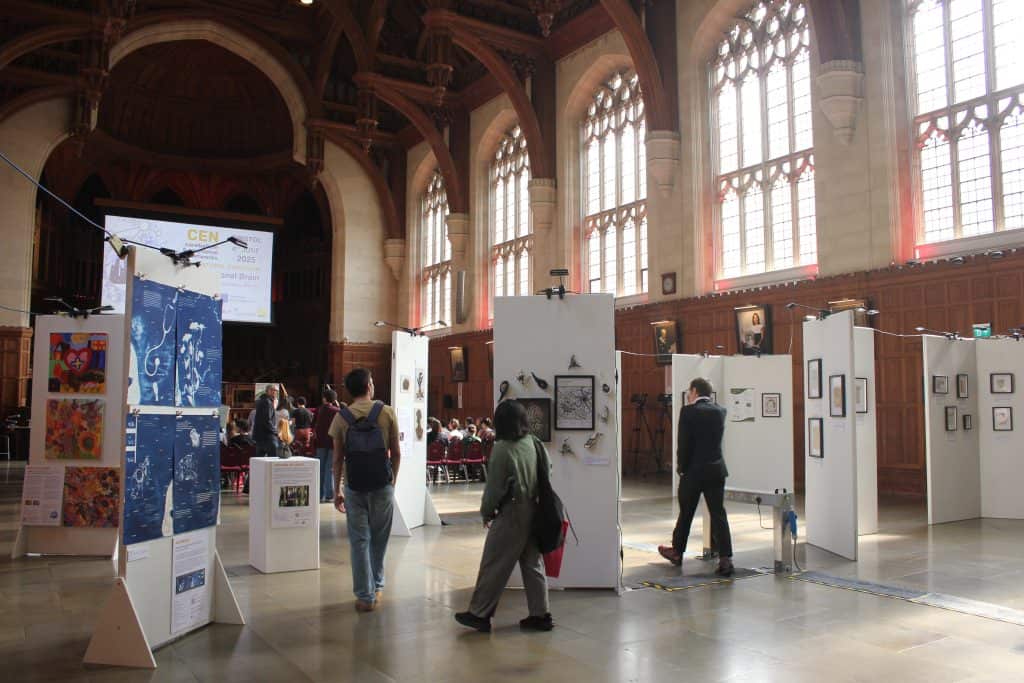
On 4 June 2025, the historic Wills Memorial Building at the University of Bristol welcomed over 150 in-person attendees, and many more joining online, for the inauguration of the traveling exhibition “The Art and Legacy of Santiago Ramón y Cajal”. The event marked the conclusion of the first day of the international conference celebrating the Cerebellum and Emotional Networks (CEN) project.
Organised by the Neuroscience Committee of the Society of Spanish Researchers in the UK (SRUK/CERU), the exhibition celebrates the scientific legacy and artistic vision of Santiago Ramón y Cajal, the Spanish Nobel laureate widely considered the father of modern neuroscience.
This event, part of a UK-wide tour following successful editions in London and Manchester, was presented in collaboration with the CEN project and the University of Bristol, marking a unique convergence of science and art.
Science Meets Art
The session was introduced and chaired by Dr. Sara Alvira de Celis, who warmly welcomed the audience and introduced the Society of Spanish Researchers in the UK (SRUK) and its Neuroscience Committee. She highlighted the importance of bridging neuroscience and the arts, a principle deeply embedded in Cajal’s legacy.
The first keynote speaker, Dr. Javier de Felipe from the Cajal Institute (CSIC), opened with “Cajal opened the path to understand the brain: Science, Art and vice versa”, a talk that traced Cajal’s groundbreaking contributions to modern neuroscience and celebrated his unmatched ability to visualize the brain’s architecture through drawing.
He was followed by Dr. Annie Campbell, Assistant Professor of Art at Auburn University (USA), who presented a compelling lecture titled “Exploring the Emotional Resonance of Brain-Inspired Sculptures.” Her talk focused on the role of ceramics in health narratives and how art can create bridges between scientific understanding and lived experience. Her work reflects on chronic illness and anatomy through sculptural form, resonating deeply with Cajal’s own interdisciplinary legacy.
An Artistic Tribute to Neuroscience
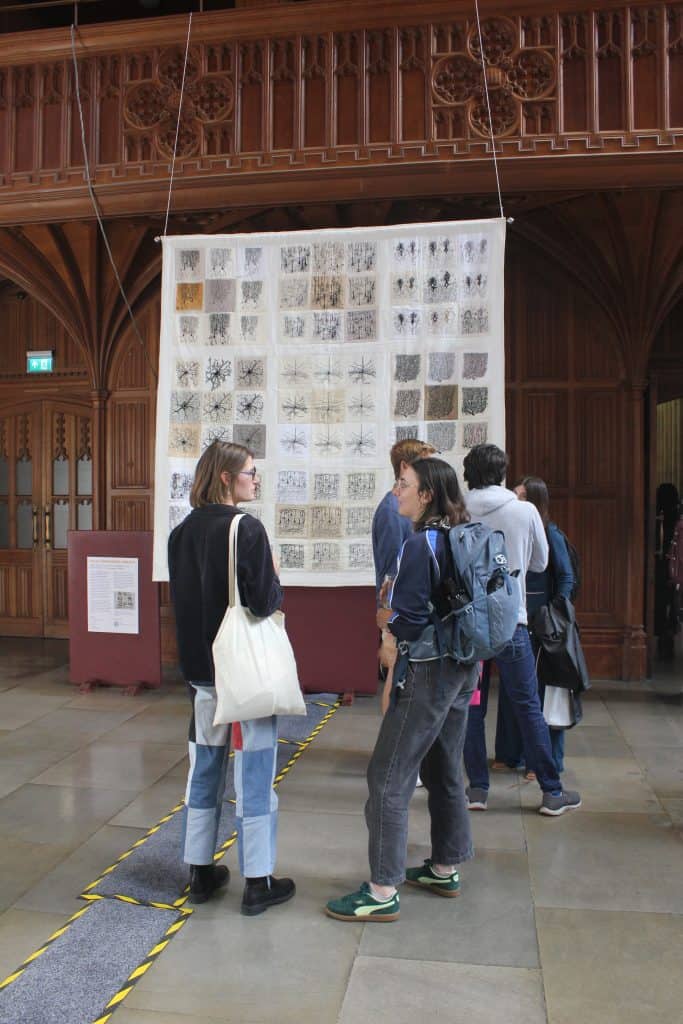
Attendees explored the exhibition, which features Cajal’s scientific illustrations alongside a satellite exhibition, Art Meets Science. This accompanying showcase includes ceramics, textiles, collaborative paintings, and sound installations by artists inspired by health, neuroscience, and nature. Visitors could follow and read posts from @RealCajal_CERU, a fictional Twitter account giving voice to Cajal’s thoughts and legacy. Additional resources were accessible via QR codes displayed throughout the panels.
A Collaborative Success
“The Art and Legacy of Santiago Ramón y Cajal” is the result of the dedication and hard work of SRUK/CERU volunteers and has been supported and funded by the Embassy of Spain in London, the Spanish Foundation for Science and Technology (FECYT), the Ramón Areces Foundation, the Instituto Cervantes in Manchester, the Spanish Consulate in Manchester, the Cerebellum and Emotional Networks (CEN) project funded by the European Union, the University of Bristol, the Centre for Languages, Culture and Communication at Imperial College London, World Women in Neuroscience, the International Brain Research Organization (IBRO), the Spanish National Research Council (CSIC), the Instituto Cajal, the National Museum of Natural Sciences (MNCN), the Camillo Golgi Museum, and the History Museum of the University of Pavia.
Exhibition Details
The exhibition is free and open to the public at the Great Hall, Wills Memorial Building, Queens Rd, Bristol BS8 1RJ:
- 4 June: 15:00 – 18:00
- 5 June: 10:00 – 18:00
- 6 June: 09:00 – 14:00
It will then be hosted at the School of Psychological Sciences, Priory Road Complex, Bristol:
- 10–27 June: 09:20 – 18:00 (weekdays).
Don’t miss this opportunity to delve into the fascinating legacy of a genius who transformed neuroscience.
Contact:
Patricia García Jareño
Chair of the SRUK/CERU Neuroscience Committee
📧 [email protected]